
The Research and Development Society has regularly made use of the Triple Chasm company's tools and frameworks, from its meso-economic vectors to its market space-centric value chains. Understanding how governmental policies impact these vectors, however, requires an extension of the model to incorporate macro-economic factors. To tackle this challenge the RDS has built a framework for linking the key macro-economic policy levers that national policymakers have control over, with the meso-economic vectors they hope to influence.
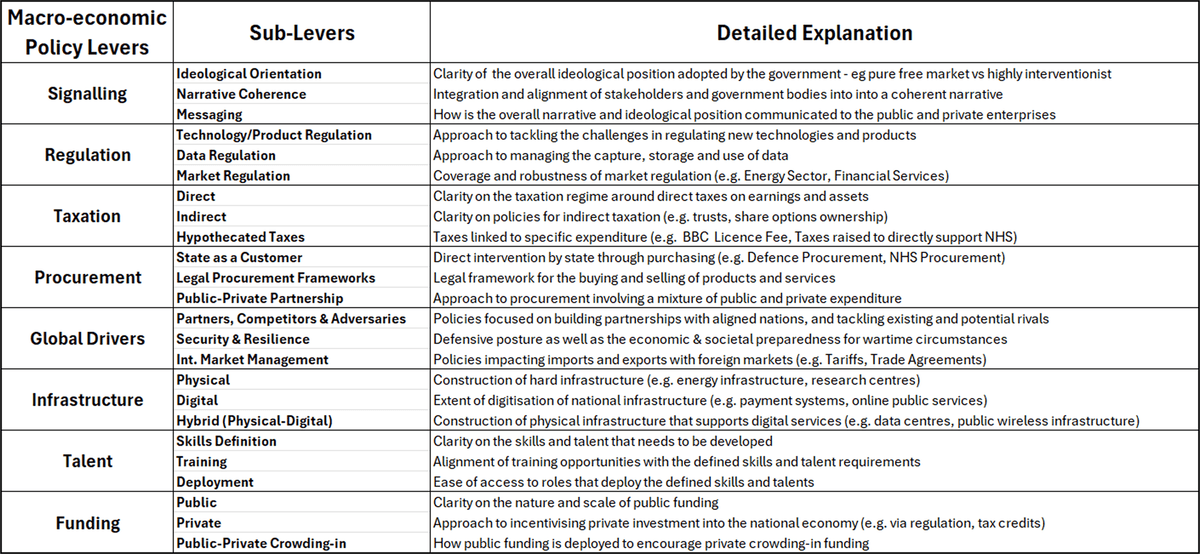
The RDS' Eight Key Macro-Economic Policy Levers
Our Macro-economic policy levers were chosen to account for all the key factors government has influence over that can influence innovation ecosystems. Any comprehensive government policy should consider how it makes use of all of these levers in its design and implementation. By linking these levers with Triple Chasm's Meso-economic vectors, we have produced a grid analysis tool for assessing how a policy platform is prioritising its different components.

Example Macro-Meso Assessment
Through assessing relevance and execution scores for each sub-lever and vector, we produce an intensity value (on a scale of 0-100). These scores capture the importance of deploying a sub-lever to support a vector, as well as the resources (actual or hypothetical) that are being directed towards it. For example, focusing on how the "State as a Customer" can boost customer definitions. When comparing the defence and life science market spaces, it has been clearly stated that public procurement is a critical aspect of the industrial strategies for both, meaning both would be given high relevance scores. However, while defence procurement is undergoing several significant reforms, NHS procurement continues to struggle with implementation, leading to a stark difference in execution scores and thus overall commercial intensity.
This framework's main value, however, lies in its potential for longitudinal analysis, through comparisons made between diagnoses and target assessments. As simple diagnosis assessments do not provide any information on what an ideal assessment should be, they cannot instruct on what changes need to be implemented. For example, while "Physical Infrastructure" may be of little significance to "Intellectual Property Management", a diagnosis will inevitably assess its intensity as very low. Despite a correct assessment, an unthinking reader may assume that more focus needs to be placed on building additional IP registration offices. A gap analysis thus allows for normalisation of the values to provide a clear picture of where a policy platform is currently succeeding or failing.
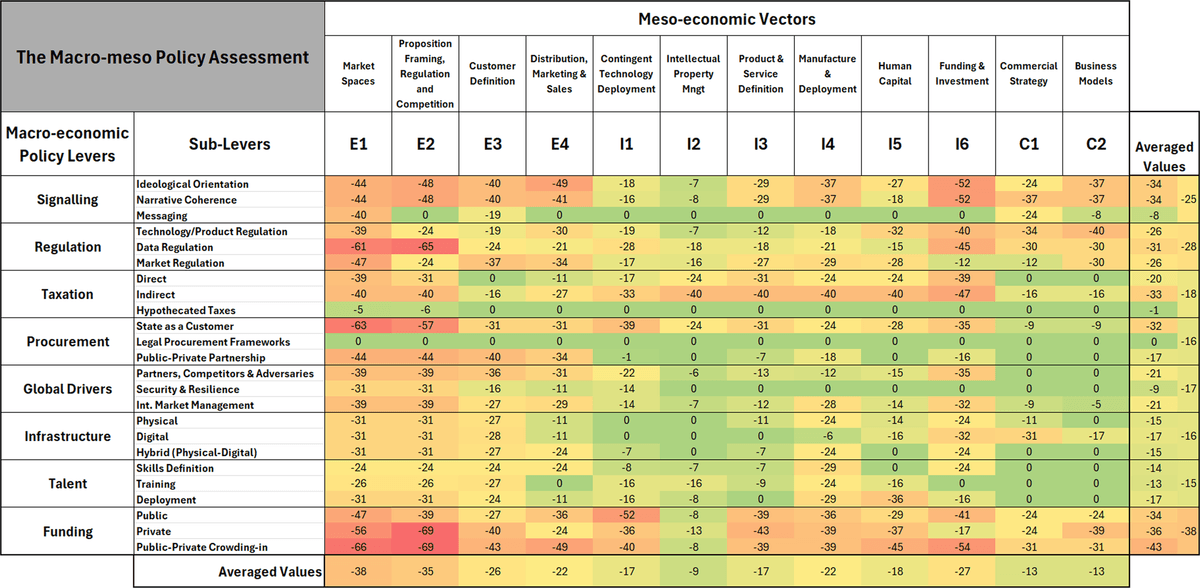
Example Macro-Meso Gap Analysis Assessment
With the announcement of our new "Big Tent" initiative on Forging the UK's AI Future, we are now excited to put our new models into practice in a formal setting with expertise provided by a host of experts from across industry and civil society.