
Why we need a new model
Previous work by the RDS has identified several key challenges facing the Government when it comes to understanding and shaping intervention strategies to drive growth:
- Poor understanding of how innovations are commercialised, focusing on macro-economic approaches that lack the underlying insights into how growth is created and instead tracking the latest ‘technology fashions’
- A limiting bi-polar approach (focusing on technology and investment) which ignores the broader growth drivers (such as market space structures and regulation) that would facilitate a nuanced multi-polar understanding
- Nurturing a more holistic appreciation of funding sources that does not excessively rely on venture capital and private equity investment and understands how their importance shifts with maturity
The validity and applicability of current growth models is unsatisfactory, especially when it comes to understanding growth and shaping policy interventions. Virtually all growth models currently focus on the macro-economic layer with passing reference to the micro-economic layer.
The macro models in general reflect abstract, aggregate approaches based on simplified thinking underpinned by neo-classical DSGE , which either explicitly or implicitly invoke the idea of the ‘invisible hand’, rather than understanding how the meso-economic layer operates. Adam Smith and many of the liberal economists he influenced were aware of the limitations of free markets, and research since then has further clarified why free markets, by themselves, often do not lead to what is best. As Stiglitz has explained, the reason that the invisible hand often seems invisible is that it is often not there! Research has shown that ‘externalities’ are pervasive, whenever there is imperfect information or imperfect risk markets—that is always. The real debate today is about finding the right balance between the role of the market and government in the economy. While the UK government has been outspoken in its rejection of these neoliberal models, the reality still falls short of the rhetoric.
The real problem is that macro-economic models largely ignore the importance of a middle layer, the meso-economic layer, where growth is generated in dynamic eco-systems. In reality, as the empirical data shows, the key drivers of growth are best understood at the interfaces between macro and meso layers; and between meso and micro layers. This is why we need to understand the coupling between the differing levels of analysis when designing any strategic interventions.
UK Growth Policy, as currently articulated by the Prime Minister’s Office and UK Treasury, still seems wedded to this neo-classical macro-economic approach, with interventions focused around “restoring stability” and “increasing investment”. While the rhetoric around growth emphasizes an interventionist approach, in practical terms, most policy announcements are still largely a continuation of previous thinking, limited by the ideological blinkers of UK macroeconomic policymaking.
Overview of the RDS Macro-Meso-Micro Model
The RDS growth model is based on global empirical data, supported by clustering analysis which identifies and groups the key variables in a structured way.
The key components of the RDS Growth Model are as follows:
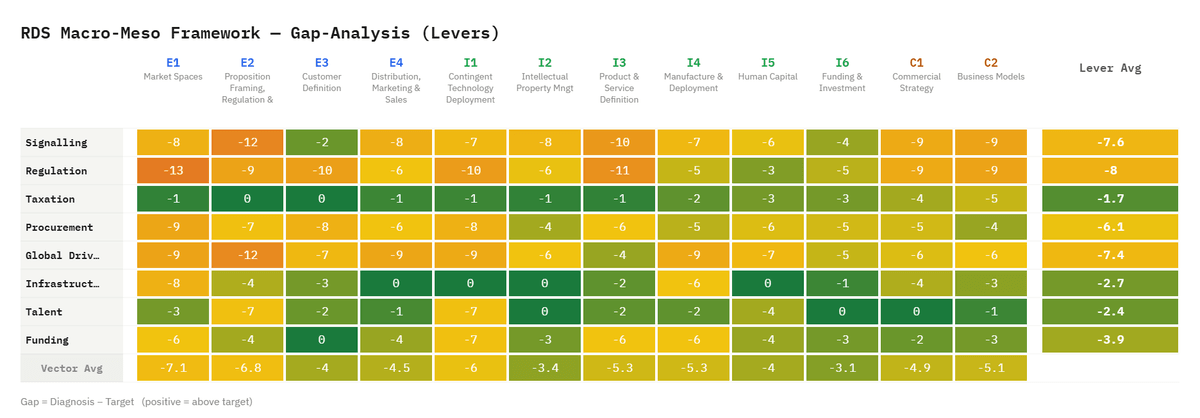
- Rigorous definition and analysis of the macro levers and sub-levers, based on extending the macroeconomic levers typically defined by fiscal and monetary policy:
- Signalling
- Regulation
- Taxation
- Procurement
- Global Drivers
- Infrastructure
- Talent
- Funding
2. Detailed examination and definition of the meso-economic vectors which drive growth in all eco-systems. This defines the following Vectors adopted from the Triple Chasm Model:
- Market Spaces
- Proposition Framing
- Customer Definition
- Distribution, Marketing & Sales
- Technology Development & Contingent Deployment
- Intellectual Property Management
- Product Synthesis
- Manufacturing & Deployment
- Human Capital
- Funding & Investment
- Strategic Positioning
- Business Models
3. Re-thinking the role of the micro layer through replacing abstract ideas of the ‘perfect’ firm with the recognition that the product, rather than the firm, is the key unit of analysis when it comes to understanding growth.
4. Understanding the coupling between the meso and micro layers when it comes to understanding the specific drivers of growth. The biggest challenge the RDS Growth Model needs to tackle head-on is how macro-economic levers interact with the meso-economic vectors in the eco-systems where growth is actually generated.
5. Modelling how the coupling between the full macro-economic levers (and sub-levers) and the meso-economic vectors holds the key to state-inspired interventions to stimulate and manage growth.
Policy Development using the RDS Growth Model
The RDS Growth Model provides a systematic framework for the development of policies focused on specific thematic initiatives. The RDS Growth model can be applied to a wide range of geographies, markets and technologies, but our initial focus is on evaluating several priority areas critical to national growth. Applying the model to major policy issues, starting with UK AI policy and to be followed by the UK Green Agenda, we can illustrate the power of an integrated and coherent approach to building new policy platforms.